
The “4 seam” fastball is one of the most important pitches in baseball. The 4-seam fastball grip allows pitchers to put all the force through the center of the baseball, causing it to have extreme velocity, which is what makes this pitch effective.

The 4-seam fastball has very little, if any, movement. Although pitchers want movement on their pitches, the “4 seam” fastball is usually the lone exception for two main reasons: location and velocity.
Check out our other FREE online pitching tools:
- Gameday Pitch Log Tracker (NEW!)
- Gameday Pitcher Stat Tracker (NEW!)
- Pitcher Batted Ball Tracker (NEW!)
- Pitch Counter
- Pitcher Stat Calculators
- Slider in Baseball
The straighter a pitch, the easier it is to consistently locate. And because the 4sf velocity is so extreme (95+ at MLB level), a pitcher can still “win” with this pitch even if it doesn’t have much movement. In this article let’s discuss how to grip a 4 seam fastball, and the importance of this pitch for success.
How to Grip a 4 Seam Fastball
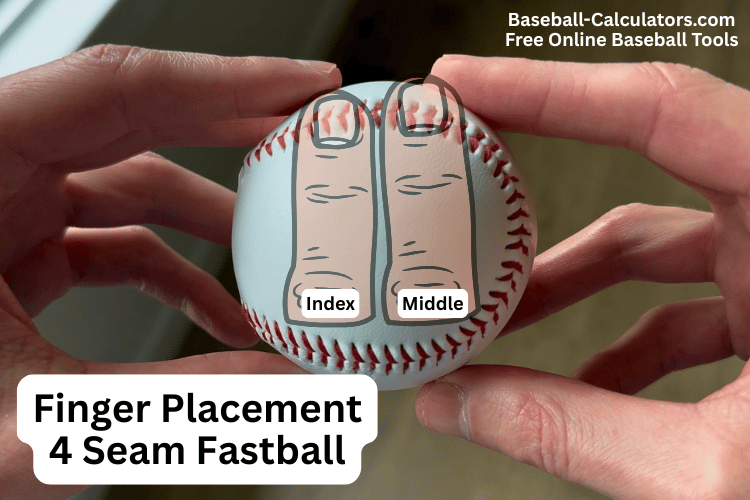
To grip a 4 seam fastball, start by placing your index and middle fingers across the horseshoe part of the seams. This means you’re gripping the ball with your fingers running across the seams, so when you throw it, the ball spins with four seams rotating in a clean, consistent pattern.

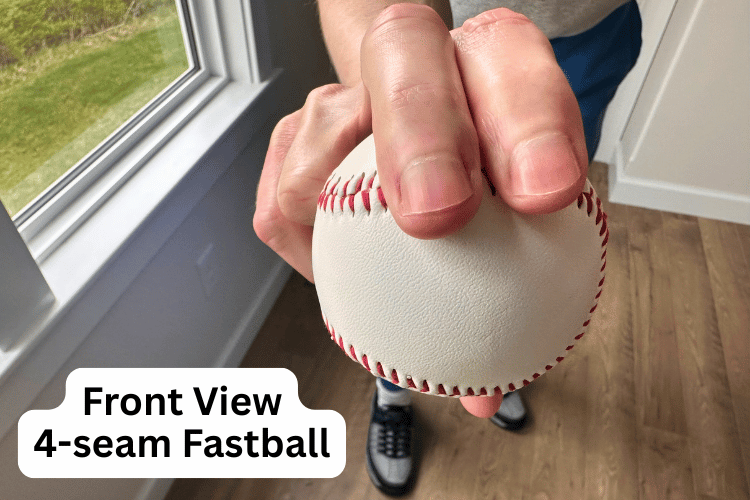
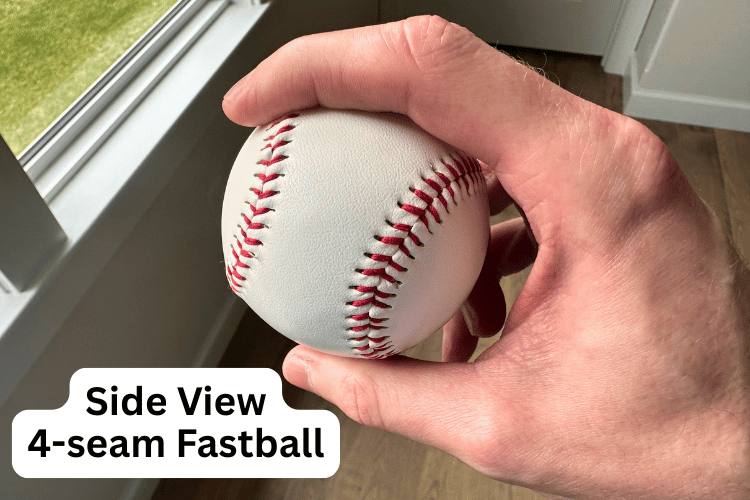
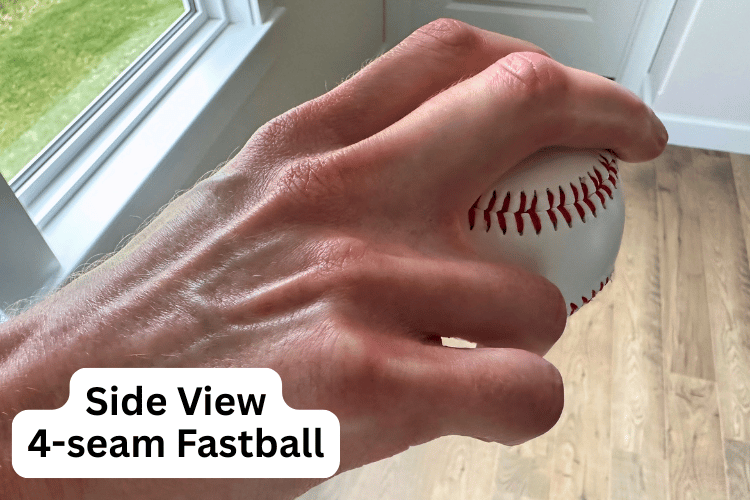
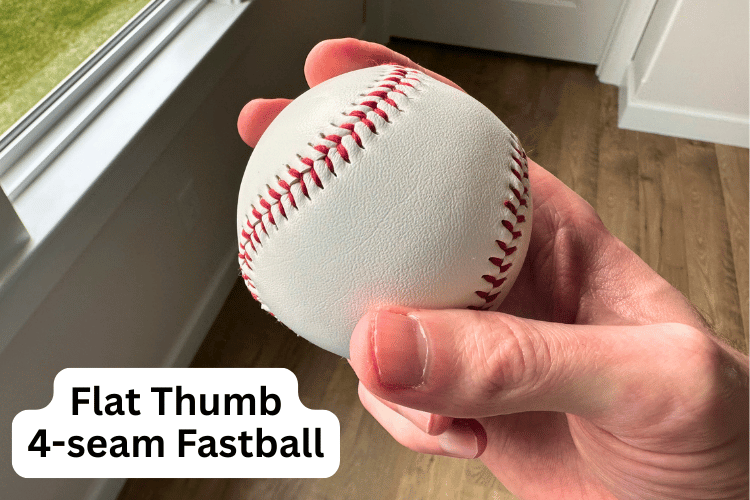
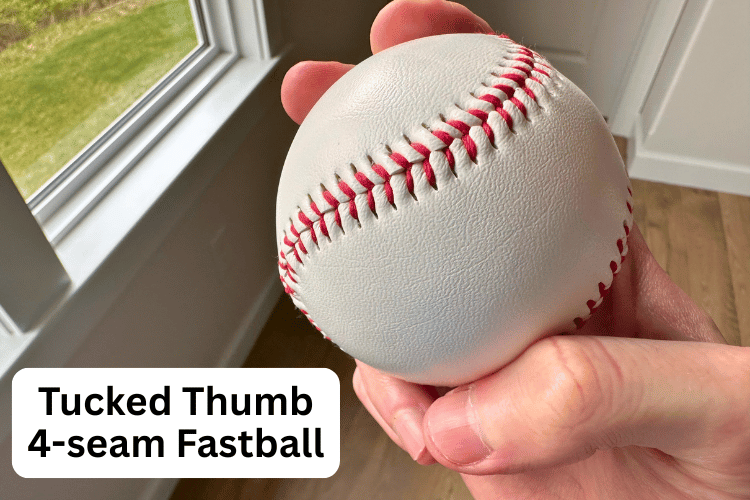
This grip and release is what creates strong backspin, which helps the ball resist gravity and gives it that rising effect hitters often describe.
Your finger pads (not the tips) should sit directly on top of the seams—not in between them and not on the slick leather. This gives you better traction as the ball leaves your hand, letting you “grab” the ball through release and produce high spin without forcing it. That clean spin is one of the key traits of a high-level four-seam fastball.
Make sure your two fingers on top are not spread too far apart. If your index and middle fingers are too wide (often called a “forked grip”) they can apply uneven force to the ball and accidentally create sidespin.
Below I took a photo of a forked grip with fingers that are too spread apart:
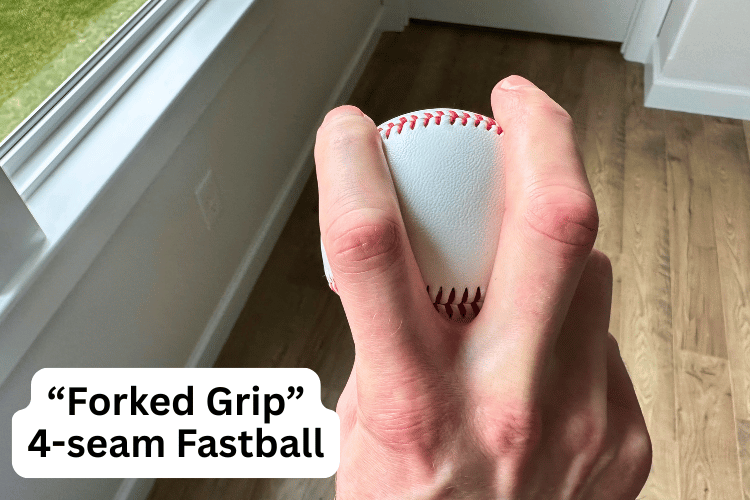
This “forked grip” can cause the fastball to cut, tail, or lose vertical break, making it less consistent and harder to control. Ideally, your fingers should be no more than a finger-width apart, and many pitchers keep them touching.
To be clear, some pitchers can make a “forked grip” work, and may actually use it to intentionally get small movement on the 4-seam fastball, but for most pitchers, the “forked grip” causes control issues.
Here is a look at the most common ways to grip the 4-seam fastball across the top:
When the fingers are close, they act more like a single, powerful unit, driving energy straight through the center of the ball. My fingers above are almost touching.
Some pitchers like to create a small gap between the fingers (not large enough to cause the forked grip). I tried to illustrate that below:
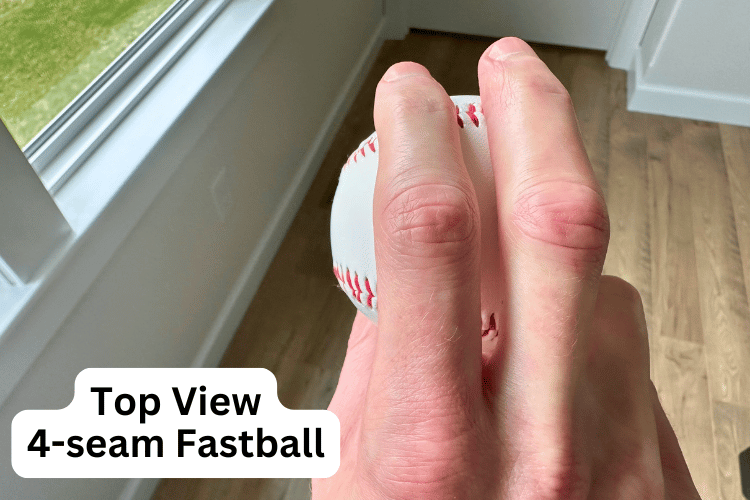
Note: If you are coaching youth players with smaller hands, don’t worry if they can’t comfortably throw the pitch with just two fingers. Using three fingers across the top—usually the index, middle, and ring—is a perfectly acceptable adjustment for youth baseball.
Thumb Placement on 4 Seam Fastball Grip
Your thumb placement should be underneath the ball, roughly aligned between your index and middle fingers. There are two common ways pitchers place their thumb: either tucked closer to the palm, or flat and extended under the ball.
I took photos of both of these thumb placements below:
While the tucked thumb can offer a more secure feeling, the flat thumb may help with hand positioning or balance. Which one works for you will be a personal preference and worth experimenting with to see what feels right for your hand.
Ring & Pinky Finger Placement on 4-Seam Fastball Grip
Keep your ring finger and pinky relaxed and off to the side, not involved in the grip. These fingers don’t need to apply pressure or steer the ball. Their only role is to provide light support, and they naturally fall away from the ball during the release.
If you apply too much pressure with the ring and pinky fingers it will affect the release, and ultimately the spin, and make the pitch hard to control and make it break in a way that a 4-seam fastball should not break.
How to Release a 4 Seam Fastball
At release, your goal is to create pure backspin with as little side spin or wobble as possible. When the spin axis of your 4-seam fastball is clean (meaning it spins directly backward like a football thrown perfectly tight) you maximize something called spin efficiency.

High spin efficiency means more of the spin you generate actually affects the ball’s flight. That’s what gives a four-seamer its carry or “hop,” helping it stay up in the zone longer and beat barrels.
Check out our other FREE online pitching tools:
- Gameday Pitch Log Tracker (NEW!)
- Gameday Pitcher Stat Tracker (NEW!)
- Pitcher Batted Ball Tracker (NEW!)
- Pitch Counter
- Pitcher Stat Calculators
- Baseball Pitching 101
To do that, you want to drive your fingers straight behind the baseball, applying force through the center of the ball and pushing it forward without twisting. As the ball rolls off your fingers, both the index and middle fingers should stay evenly involved.
If one finger dominates the release—especially the middle finger—you can end up with unintentional gyro spin, which causes the ball to spiral and lose vertical lift. That spiral spin is great for breaking balls, but for a fastball, it’s a problem.
This problem is reasonably common and can cause unintentional cutting of the baseball and cause your 4-seam fastball to veer off target late in the pitch path. To combat this issue, some pitchers will rotate the ball slightly in their grip.
For example, right-handed pitchers can turn the ball clockwise and left-handers can turn the ball counter-clockwise (slightly), shifting the seam orientation just enough so that the fingers can now stay centered as the ball comes off (instead of being dominated by the middle finger).
This tactic is sometimes referred to as an “offset grip”, and it’s a good fix for pitchers who are consistently cutting the ball without meaning to. If you feel like you need to use an offset 4 seam fastball grip, and want to do a deeper dive, I’d recommend this resource.
Finishing the Release of a 4-Seam Fastball
Once you’re confident in your finger pressure and grip orientation, the next big key is how you finish the pitch. You don’t want to push the ball or guide it—you want to whip it.
The best four-seamers come from a strong late acceleration at the very end of the arm path. Think of it like cracking a whip or trying to throw through a brick wall, not just to it. That late hand speed and wrist extension helps the ball spin faster, jump out of the hand, and carry better through the zone.
But finishing hard doesn’t mean overthrowing or hurting yourself. You still need to stay under control. Great pitchers know how to move explosively while maintaining balance and direction.
They also know that the release happens in the last split-second, and that’s where focus really counts. If you’re rushing or losing connection to your target, it’s easy for the ball to come out early, late, or with unintended spin.
Variations of 4 Seam Fastball Grip
Most pitchers learn the standard four-seam grip early on, but once that basic grip is comfortable, small changes can unlock more movement, better spin, or better command. Above, we discussed the “offset grip” that some pitchers use to correct the problem of a dominant middle finger.
“Most pitchers learn the standard four-seam grip early on, but once that basic grip is comfortable, small changes can unlock more movement, better spin, or better command.”
But, there are other, more advanced, grip variations for a 4-seam fastball. Please understand that these grip variations are meant for advanced, high-level pitchers who understand how even subtle differences can shape the profile of their fastball.
At its core, the standard four-seam grip involves placing your index and middle fingers across the horseshoe of the seams, with your thumb underneath the ball. But every pitcher’s hand is built a little differently, so even if two players start with the same grip, the result can vary depending on finger length, hand size, pressure points, or release patterns.
“Every pitcher’s hand is built a little differently, so even if two players start with the same grip, the result can vary depending on finger length, hand size, pressure points, or release patterns.”
If you are interested in doing a deeper dive in grip variations, I’d advise you to visit this Driveline Baseball video here that discusses these grips in more detail. Below is a summary of these grips.
4S1 Standard Grip
This is your baseline four-seam fastball grip that we have discussed. Fingers are placed naturally across the seams with a neutral hand position.
The large majority of 4-seam fastballs are thrown in this manner. It’s simple, repeatable, and allows for high spin efficiency when executed properly. Most pitchers should start here, especially when working on command and consistency.
4S2 Fingers Pressed Together
In this variation, the index and middle fingers are pressed tightly together, rather than being spaced apart slightly. This grip helps pitchers who tend to let the ball peel off the middle finger early in their release.
When that happens, spin efficiency drops, and the ball may lose vertical break or cut unintentionally. Pressing the fingers together creates more uniform pressure and encourages a centered release, improving spin consistency and helping to maintain the desired flight path.
4S3 Widened Fingers
Here, the fingers are spaced farther apart than usual. This variation is often used by pitchers looking to intentionally create slight cut. By widening the fingers, especially if the middle finger is slightly dominant at release, the ball can take on a more cutting profile—even if it’s still classified as a four-seamer.
It’s not a full-blown cutter, but it’s a useful tool for pitchers who can’t get the pure ride they want and want to shape the fastball differently. This is also a way for pitchers to work with their natural release pattern instead of fighting against it.
As we discussed earlier, if your fingers are spread too wide, this creates a “forked grip” which can be very hard to control – use this grip with caution as it changes the movement on a 4-seam fastball.
Seam Orientation and Subtle Grip Differences
Though often overlooked, the orientation and direction of the seams on a baseball can influence how a 4 seam fastball feels coming out of the hand (and potentially how it performs). While most players are aware of how to align their fingers across the seams, few consider the direction in which the stitches run along those seams.
This detail, while small, may contribute to subtle but meaningful differences in grip comfort and, therefore, release consistency. Several elite Japanese pitchers (Yoshimi, Fujikawa, and Kaneko) have noted through personal experience that certain seam directions feel less slippery and help them generate more spin.
Check out our other FREE online pitching tools:
- Gameday Pitch Log Tracker (NEW!)
- Gameday Pitcher Stat Tracker (NEW!)
- Pitcher Batted Ball Tracker (NEW!)
- Pitch Counter
- Pitcher Stat Calculators
- Baseball Pitching 101
Specifically, they preferred a grip known as the 4 seam I, which, although nearly identical in seam orientation to the 4 seam II, features a reversed seam direction (both pictured below). That minor shift in tactile feedback, how the stitches feel against the pads of the fingers, can influence the level of grip security, which in turn affects control and spin rate.
Below are photos I took for 4 seam grip, and the different seam orientations:

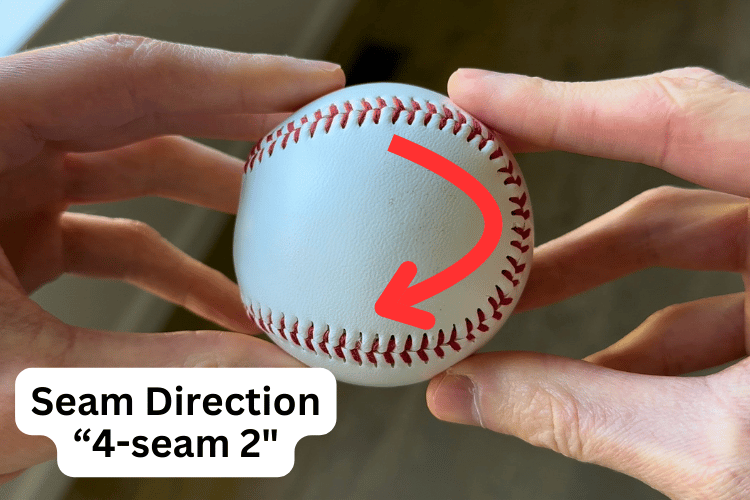
To be clear, there is not a verified right or wrong seam direction (meaning, choose which one feels best for you). Most pitchers do not actively monitor seam direction, but because of that, many may unknowingly switch between seam orientations that feel similar but produce (potentially) slightly different results.
Over time, these variations can show up as inconsistency in pitch movement, release feel, or command even when everything else seems unchanged. Because the difference is subtle and tactile, it is easy for pitchers to miss what is actually going wrong.
This is why it may be worth tracking outcomes based on seam orientation. Paying attention to how the ball feels in the hand and monitoring whether certain seam directions correlate with better command, higher spin, or improved comfort. This article is a great resource to do a deep dive on this issue.
How Pros Use the 4 Seam Fastball
| 4-Seam Fastball Summary | |
|---|---|
| Speed at Pro Level | 92-97 mph standard 100+ mph possible |
| Effectiveness | High velocity beats hitters Best when elevated in zone |
| Movement | Minimal to none Straight path aids location |
| Value | Reliable strike pitch Misses bats at 95+ mph |
The “4 seam” fastball is one of the most important pitches in baseball. As we have discussed above, the 4 seam fastball grip allows pitchers to put all the force through the center of the baseball, causing it to have extreme velocity, which is what makes this pitch effective.
Some professional pitchers can throw 4-seam fastballs at 100 mph or more (although the standard is more 92-97ish). As you can imagine, this is very difficult to hit.
“4-seam fastballs are very effective when they are elevated at the top part of the strike zone.”
At this extreme velocity (95mph+), it can be an effective pitch no matter where it is located (although pitchers always try to avoid the middle of the strike zone). “4 seam” fastballs are very effective when they are elevated at the top part of the strike zone, like this:
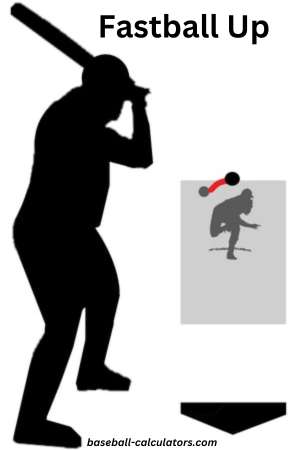
Professional pitchers will use 4-seam fastballs up in the zone to trick hitters. From the batter’s perspective, the pitch is centered on the plate and elevated so it looks very hittable (hitters like pitches up in the zone because you can get under the baseball and elevate it and drive it).
But because there is so much velocity on a 4-seam fastball, most hitters don’t have the bat speed to catch up to a fastball that high up in the zone. So they swing at a pitch that looks good, but one that they can’t catch up to and make contact with.
Check out our other FREE online pitching tools:
- Gameday Pitch Log Tracker (NEW!)
- Gameday Pitcher Stat Tracker (NEW!)
- Pitcher Batted Ball Tracker (NEW!)
- Pitch Counter
- Pitcher Stat Calculators
- Baseball Pitching 101
Because of this, 4-seam fastballs up in the zone are very effective for professional pitchers. If a pitcher throws 95 mph or more with their 4-seam fastball, as long as they miss the heart of the plate, all locations for a pitch that fast can be effective and difficult for professional hitters to handle.
4 Seam Fastball Movement
The 4-seam fastball has very little, if any, movement. Although pitchers want movement on their pitches, the “4 seam” fastball is usually the lone exception for two main reasons: location and velocity.
“The 4-seam fastball has very little, if any, movement.”
Straight baseball pitches are more reliable and easier to locate. Sometimes, pitchers must throw a strike. And if all of their pitches have late movement, that means they would have a difficult time locating a quality strike (like on the corner) when they absolutely needed to.
A straight pitch is easier to locate than a pitch that cuts, curves or sinks to create movement and deception.
Minimal movement May seem to “rise” Straight by design
Easier to locate Reliable strike pitch Wins with 95+ mph
Straighter = faster Even grip pressure No side spin
A fast 4-seam fastball allows a pitcher to throw a pitch they trust they can locate (because it doesn’t move much), but because the velocity is so extreme (95+), they can still “win” with this pitch. Straight makes the location predictable (for both the hitter and batter) but the extreme velocity still makes it difficult for a batter to square up.
Also, the straighter the pitch, the more velocity it has. The spin that generates movement also slows a pitch down a few miles per hour. If a pitcher uses a “4 seam” fastball, they generally want to throw it as hard as they can.
“4 seam grip allows a pitcher to put pressure evenly through the center of the baseball.”
To do this, they will use a 4 seam fastball grip that allows them to put pressure evenly through the center of the baseball, which drives the baseball forward without favoring one side of the ball over the other, which eliminates side spin and subsequently, movement (making the pitch straight).
The Value of a 4-Seam Fastball
There are many ways to succeed as a big league pitcher, but one of the most common traits in a successful professional pitcher is a quality fastball. As we discussed above, the 4-seam fastball is the easiest pitch to locate. And being able to locate pitches is extremely important for pitchers.
“There are many ways to succeed as a big league pitcher, but one of the most common traits in a successful professional pitcher is a quality fastball.”
What a quality 4-seam fastball allows a pitcher to do is if they fall behind in a count (for example 3-1) and they must throw a strike, it allows them to use a pitch they trust they can locate as a strike (because movement is minimal) but if it is a quality 4-seamer (95+mph) they also can still beat a hitter with it.
Compare that with, for example, a two-seam fastball. 2 seamers trick hitters with late diving action which makes them difficult to square up and hit. But the problem for pitchers is this: because a 2-seamer moves so much, it is often difficult to consistently locate it. Read more: 2 seam vs 4 seam fastball
Easiest to locate Reliable strike pitch Key for most pitchers
3-1 count savior 95+ mph beats hitters Unlike risky curveballs
Strike zone dominance Misses bats at 95+ Induces weak contact
So if they are behind in a count and need to throw a strike, it is risky to rely on a pitch like a curveball that has a lot of movement. However, it is also important to understand that some professional pitchers are so good, that they can even consistently locate pitches that have a lot of movement. This is what makes these pitchers the best of the best.
But many professional pitchers cannot locate (consistently) their pitches with the most movement. For these pitchers, the fastball is what they rely on.
“A quality ‘4 seam’ fastball is not only hard for the hitter to hit, but it is also easy for the pitcher to locate.”
If they have a quality, hard 4-seam fastball that they can consistently locate as a strike, they can throw it in counts where they must throw a strike, but because the pitch is so fast, they can still miss a bat with it.
Success as a big league pitcher is dependent on many things, but perhaps the most important is this: can they throw a pitch in the strike zone and still miss a bat? Sure, any professional pitcher could avoid contact by throwing balls out of the zone, but this would fail long term as a strategy because hitters would wise-up and take walks.
“Success as a big league pitcher is dependent on many things, but perhaps the most important is this: can they throw a pitch in the strike zone and still miss a bat?”
Eventually, pitchers must throw strikes.
And the elite pitchers have such quality pitches, that they can throw pitches in the strike zone, and still miss bats and/or induce weak contact. Quality “4 seam” fastballs (95+mph) is one of the best baseball pitches for achieving this, because not only is it hard for the hitter to hit, but it is also easy for the pitcher to locate.
Common Mistakes When Throwing a 4 Seam Fastball
Even though the four-seam fastball is the most basic pitch in baseball, it’s surprisingly easy to get wrong. Many pitchers develop habits that limit how effective their fastball can be, often without realizing it.
These mistakes can show up in the 4 seam fastball grip, the release, or even in how a pitcher finishes the throw. When something feels off—maybe the pitch is cutting, sailing, or just lacking that extra life—there’s usually a small mechanic or grip detail behind it. The good news is most of these issues have simple fixes, but the first step is knowing what to look for.
Gripping the Ball Off the Seams
One of the most common mistakes pitchers make is not actually using the seams correctly. A proper four-seam grip requires the index and middle fingers to sit directly on top of the seams, specifically across the horseshoe.
The pads of the fingers should touch the seam, not the smooth leather in between. This detail is often missed, especially by younger players or those who were never taught how to hold the ball with purpose.
When a pitcher grips the ball between the seams rather than on top of them, they lose traction at release. That loss of grip reduces spin and makes it harder to get a clean, tight rotation.
As a result, the ball may come out with less backspin, lower spin efficiency, and unpredictable movement. It might flutter, cut slightly, or just fall flatter than expected. The fastball loses its life, and hitters can pick it up easier out of the hand.
Forking the Fingers Too Wide
I discussed this earlier in the article, but another common issue with the four-seam fastball grip comes from how far apart a pitcher places their index and middle fingers. When those fingers are spread too wide—what’s often called a “forked grip”—it changes how force is applied to the ball and opens the door for problems with spin direction and consistency.
This usually happens because the pitcher is trying to get more control or comfort, but it ends up creating more issues than it solves. When your fingers are too far apart, they act more like two separate levers rather than one unified force.
Instead of driving the ball straight through the center, the pressure can get split unevenly, especially if one finger releases slightly before the other. This causes side spin or tilted spin axis, which reduces the vertical carry of the fastball and often leads to unintentional cut or tailing action.
The pitch might start to run to the glove side or dive out of the strike zone unpredictably. This also affects command. A forked grip makes it harder to repeat the release because your fingers aren’t working together.
If one finger drags or pushes slightly more than the other, the pitch location changes. You may not feel it happen, but the ball ends up sailing arm-side or fading to the opposite corner. The fix is to narrow the gap between your fingers.
In most cases, keeping your index and middle finger within one finger-width of each other is ideal (shown above). Many pitchers even prefer to have them touching.
This allows your fingers to apply force as one unit and drive the ball through the centerline, which helps you stay behind the ball and improves spin consistency.
Thumb in the Wrong Position
As I discussed earlier, thumb placement might seem like a small detail, but it plays a major role in stability, balance, and control during the throw. When the thumb is in the wrong spot—too far to the side, angled awkwardly, or positioned off-center—it can throw off the entire grip and negatively affect how the ball comes out of your hand.
Check out our other FREE online pitching tools:
- Gameday Pitch Log Tracker (NEW!)
- Gameday Pitcher Stat Tracker (NEW!)
- Pitcher Batted Ball Tracker (NEW!)
- Pitch Counter
- Pitcher Stat Calculators
- Baseball Pitching 101
The thumb’s job is to support the baseball from underneath and keep it stable as your fingers apply pressure on top. If your thumb is too far to one side or angled inward, the ball can tilt in your hand, and that changes how your fingers interact with the seams during the release.
Correct thumb position:
That tilt often creates slight sidespin or wobble, which kills spin efficiency and reduces the fastball’s carry. You may feel like you’re staying behind the ball, but the ball itself is actually leaving your hand off-axis.
A poorly placed thumb can also lead to command issues. When the ball doesn’t sit comfortably in your hand, you may start squeezing it too tightly or adjusting your wrist angle subconsciously to compensate. That tension can lead to erratic throws or inconsistent release points.
The fix is to reposition your thumb so it rests directly under the baseball, centered between your index and middle fingers. Some pitchers prefer a tucked thumb, which sits closer to the palm and provides a snug fit.
Others like a flat thumb, which stretches farther along the bottom of the ball and offers a looser, more relaxed feel. The key is that the thumb should support the ball in a way that keeps it level, balanced, and aligned with your intended release path.
Letting the Middle Finger Dominate the Release
One of the more subtle but damaging mistakes a pitcher can make when throwing a 4-seam fastball is letting the middle finger take over during the release. This usually happens without the pitcher realizing it and often shows up in the form of unwanted cut or inconsistent spin.
“One of the more subtle but damaging mistakes a pitcher can make when throwing a 4-seam fastball is letting the middle finger take over during the release.”
Because the middle finger is slightly longer and naturally stronger than the index, it’s easy for it to overtake the throw if the grip and mechanics aren’t dialed in. When the middle finger dominates, the ball peels off that side just a fraction of a second later than it should.
That tiny delay shifts the spin axis and adds a touch of side spin to the ball. Instead of spinning cleanly with pure backspin, the 4-seam fastball rotates at a slight angle, reducing vertical break and making the pitch move in a way the pitcher didn’t intend.
Check out our other FREE online pitching tools:
- Gameday Pitch Log Tracker (NEW!)
- Gameday Pitcher Stat Tracker (NEW!)
- Pitcher Batted Ball Tracker (NEW!)
- Pitch Counter
- Pitcher Stat Calculators
- Baseball Pitching 101
This is one of the most common causes of unintentional cutting action. You might notice that your 4-seamer starts on target but drifts away from the strike zone or moves more to the glove side than expected.
It may even cut just enough to miss barrels on accident, which can be helpful at times but also hard to control consistently. Over time, this kind of release pattern can throw off your command and make it hard to trust your fastball location.
“Over time, this kind of release pattern can throw off your command and make it hard to trust your fastball location.”
To fix this, start by checking how the ball sits in your hand. If the middle finger naturally ends up more toward the center of the ball, that’s often a red flag. As we discussed earlier in the article, one solution is to rotate the ball slightly in your grip (clockwise if you’re a righty, counter-clockwise if you’re a lefty).
This offset grip moves the seams just enough to allow both fingers to share the load more evenly during release. With the fingers now better centered behind the ball, you’re more likely to generate clean, efficient spin with no unintentional tilt.
Another helpful adjustment is to bring the index and middle fingers closer together. When they act as a unified force, rather than two separate levers, they release the ball more cleanly and with better balance.
Not Staying Behind the Baseball
Staying behind the baseball is one of the most important principles in throwing a high-quality four-seam fastball, yet it’s also one of the most overlooked. When a pitcher says their fastball doesn’t “feel right” or it’s not getting the ride or carry they expect, there’s a good chance they’re not staying behind the ball at release.
“When a pitcher says their fastball doesn’t “feel right” or it’s not getting the ride or carry they expect, there’s a good chance they’re not staying behind the ball at release.”
This doesn’t mean their mechanics are totally broken—it often comes down to hand position and how their fingers interact with the ball in the final moments of the release. When a pitcher fails to stay behind the ball, their hand usually drifts around the side of it.
Instead of applying force directly through the center and creating true backspin, they apply pressure at an angle. That changes the spin axis and often results in a tilted or slightly sideways spin.
“That changes the spin axis and often results in a tilted or slightly sideways spin.”
The 4-seamer might still be firm and look decent, but it won’t have the same vertical break, and it may start to tail or drift. This kind of movement isn’t always dramatic, but it robs the pitch of its life and can make it easier for hitters to track.
The root cause is often tied to mechanics and timing. If your arm lags behind your body, or your front side opens too early, your throwing hand has to play catch-up. That compensation can lead to an off-angle release where your hand ends up beside the ball instead of behind it.
Another issue can be wrist position. If your wrist is too relaxed or cocked outward, you’re more likely to come around the ball at the finish. To fix this, you need to build a feel for driving your fingers directly through the center of the ball.
“One helpful cue is to imagine throwing the ball through the catcher’s glove, not to it.”
One helpful cue is to imagine throwing the ball through the catcher’s glove, not to it. That encourages late acceleration and a strong finish right behind the ball. Another good cue is to picture the ball as a wheel rolling forward—you want to make it spin cleanly over the top, with no tilt to the side.
Video can help here. Even a slow-motion clip on a phone can show whether your hand is behind the ball or drifting to the side. If you see your wrist rolling off or your arm flying across your body, that’s a clue that you’re not staying in line.
Overgripping or Squeezing the Ball Too Hard
Gripping the ball too tightly on a 4-seam fastball is a common mistake, especially for pitchers who are trying to throw harder or feel more in control. The instinct makes sense—if you want to throw a pitch with conviction, your body naturally wants to tense up and hold on tighter.
But when it comes to the four-seam fastball, squeezing the ball too hard often does more harm than good. When you over-grip the ball, your hand gets stiff, your wrist locks up, and your fingers lose the quick, clean action needed to spin the ball properly.
This usually leads to a slower arm, reduced spin rate, and a “draggy” release that can throw off both velocity and movement. The ball may also come off your fingers unevenly, which adds wobble or sidespin and lowers spin efficiency.
The fix is learning to hold the ball with a firm but relaxed grip. You want to feel the seams under your fingers, but you don’t want to choke the life out of the ball. Think of it like holding a bird—you want to keep it from flying away, but not so tight that you hurt it.
Releasing Too Early or Too Late
Timing the release window is one of the most delicate parts of throwing a four-seam fastball. Even if your grip and mechanics are solid, if the ball comes out of your hand too early or too late, you’re going to struggle with command, movement, and velocity.
“When you release the ball too early, you lose leverage.”
The difference between a perfectly timed release and a poorly timed one can be a matter of milliseconds, but the results are easy to spot.
When you release the ball too early, you lose leverage. The pitch often sails high or arm-side and lacks backspin because you didn’t stay through it long enough to generate a strong finish.
On the other hand, if you hold onto the ball too long and release it late, the pitch can dive into the dirt or pull glove-side. A late release often creates a dragging sensation, and it can introduce sidespin if your hand starts to rotate past the center of the ball.
A helpful approach is using video to check your arm slot and release point. If you consistently miss high or low, the release timing is usually the culprit. Slow-motion clips can help reveal whether your hand is letting go too soon or too late.
Overthrowing Instead of Finishing Smooth
Trying to throw the 4-seam fastball as hard as possible is a natural instinct, especially for competitive pitchers who want to light up the radar gun or blow a pitch by a hitter.
But there’s a difference between throwing hard and overthrowing, and that difference can make or break the quality of your four-seam fastball. Overthrowing usually happens when a pitcher puts too much emphasis on effort and not enough on timing, rhythm, and finish.
When you overthrow, your body tenses up. Your arm may try to speed up too early in the delivery, and that kills the whip effect you need at the end. You often end up pushing the ball instead of letting it snap out of your hand.
The pitch might still have decent velocity, but the movement and spin suffer. It may feel like you’re doing more, but you’re actually getting less. Spin rate tends to drop, your release point can vary wildly, and you lose the late life that makes a fastball play up in the zone.
Another issue with overthrowing is that it often causes mechanical breakdowns. You may fly open with your front side, yank your head off line, or get too rotational with your upper body. All of these things make it harder to stay behind the ball and finish through your target.
Ignoring Feedback from Ball Flight
One of the biggest mistakes a pitcher can make—especially once they’ve been throwing for a while—is ignoring what the ball is actually doing in the air. You can have the perfect 4-seam fastball grip, smooth mechanics, and a great release, but if the ball isn’t moving the way it’s supposed to, something’s off.
A lot of pitchers fall into the habit of judging their fastball only by how it feels or how hard they think they threw it. The problem is that the ball doesn’t lie. If it’s cutting, tailing, staying flat, or consistently missing the target, it’s giving you valuable feedback that something needs adjusting.
Ball flight tells you whether you’re getting behind the ball, staying through the finish, and releasing at the right time. It shows whether your grip is working for your hand, whether your spin is clean, and whether your mechanics are repeatable.
If your fastball doesn’t carry through the zone or doesn’t have that late life, even if it feels good out of the hand, that’s a sign something needs to be rechecked—starting with your grip and release.
The fix is to start treating each throw like a test. Watch the shape of the pitch. Notice how it moves, where it finishes, and whether it does what you expected.
If you’re getting unintentional cut or tail, look at your finger spacing, thumb position, and whether you’re staying behind the ball. If your fastball is consistently missing arm-side or high, the issue could be your release timing or how your wrist is finishing. Even subtle changes like finger pressure or seam orientation can affect how the pitch plays.
Check out our other FREE online pitching tools: