
The slider is one of the most deceptive pitches in baseball. The slider grip allows pitchers to create spin as the ball is released, which causes late, deceptive sinking action and makes this pitch very effective.

The slider movement is always to the pitcher’s glove-side. The slider is one of the most effective and commonly-used breaking balls in baseball and is known for its ability to deceive hitters and cause hitters to swing and miss.
Check out our other FREE online pitching tools:
- Gameday Pitching Tracker (NEW!)
- Gameday Pitch Stat Keeper (NEW!)
- Pitcher Batted Ball Rate Tracker (NEW!)
- Pitch Counter Tool
- Pitcher Stat Calculators
- Baseball Pitching Explained
The late “sliding” movement on a slider makes it an effective way to miss the barrel of a bat. However, there are many different ways to grip a slider and ultimately a pitcher will use the grip he is most comfortable with and gets the most consistent results with. Let’s take a look at slider grips.
How to Grip a Slider in Baseball
Most pitchers who throw an effective slider use one of a few trusted grips that have stood the test of time. These slider grips may vary slightly from one pitcher to the next, but they all share the same common goal: positioning the fingers in a way that creates strong, tilted spin.
The “Offset” Slider Grip
The most widely used grip for throwing a slider is often referred to as the “offset” two-seam grip (or sometimes called the “between” grip). It starts with the same seam orientation as a typical two-seam fastball, but with a subtle adjustment that allows the pitcher to apply more pressure to one side of the ball.
Below I put a picture of this offset slider grip so you can see how this slider grip just slides the index finger over onto the smooth part of the leather:
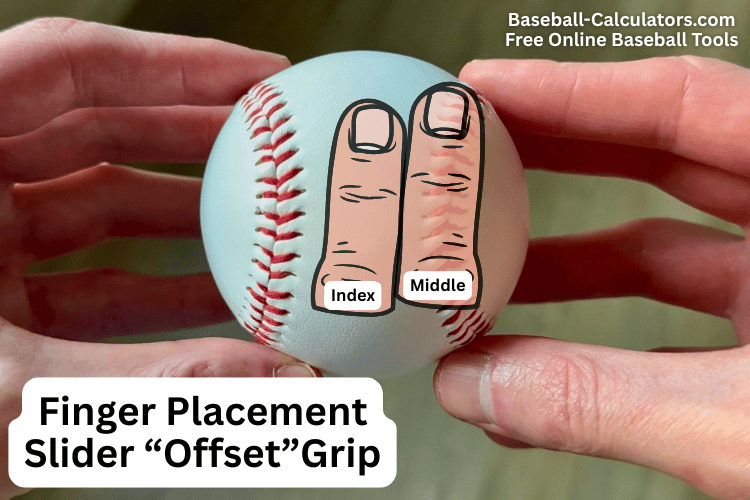

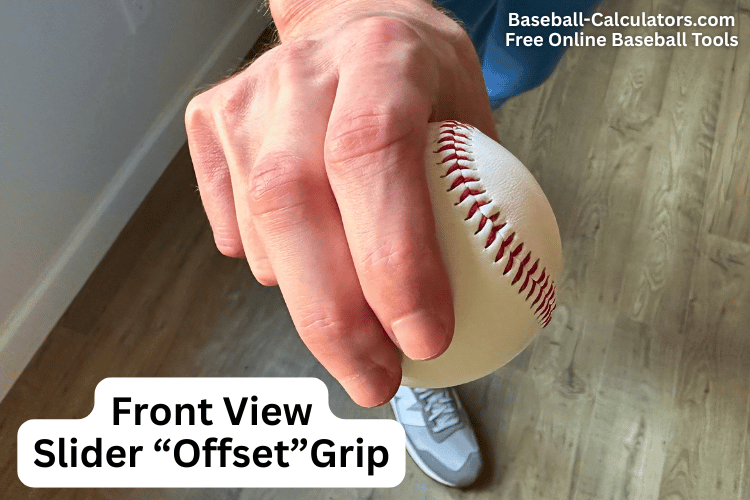
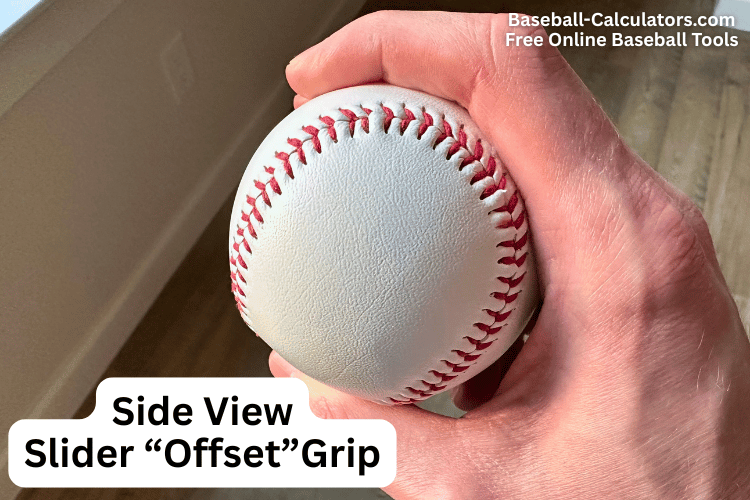
Your middle finger should be placed directly along the seam on the arm-side of the ball. The index finger rests right next to it, but (again) usually on the smooth part of the leather.
Some pitchers may slightly alter this grip by bending or spiking their index finger to take pressure off of it and make the middle finger the dominant point of contact during release. Here is a look at a spiked index finger in combination with this grip:
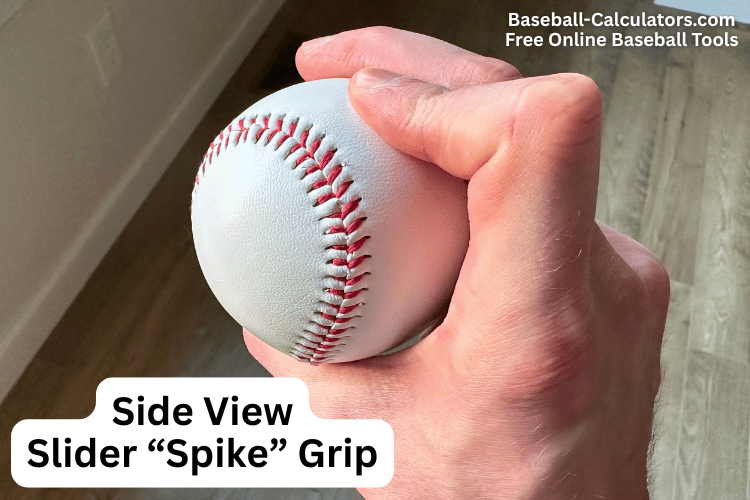
The thumb position can vary based on comfort, but many pitchers prefer to set it either directly underneath the ball or just slightly off to the side, often grabbing a seam if it helps with control.
The goal is to allow the ball to stay in the hand just long enough to apply pressure with the fingertips, but not so long that it delays release or shifts the spin axis in the wrong direction. With this grip, the ball should come out clean and create that sweeping, late-breaking action.
This offset slider grip is considered the most common because it strikes a balance between control, comfort, and movement. For many pitchers, especially those transitioning from a fastball or curveball, it feels natural in the hand and doesn’t require extreme wrist angles or unnatural finger pressure.
Check out our other FREE online pitching tools:
- Gameday Pitching Tracker (NEW!)
- Gameday Pitch Stat Keeper (NEW!)
- Pitcher Batted Ball Rate Tracker (NEW!)
- Pitch Counter Tool
- Pitcher Stat Calculators
- Baseball Pitching Explained
It also allows for consistent release timing, which is critical for throwing a slider. Since the pressure is mostly applied by the middle finger and the grip keeps the hand slightly to the side of the ball, it produces reliable horizontal movement without sacrificing too much velocity.
The “Horseshoe” Slider Grip
Another frequently used variation is the horseshoe slider grip, which gets its name from the distinctive “U” shape formed by the seams on a baseball. In this grip, the pitcher turns the ball so the horseshoe faces them (photo scroll down), then places their fingers along or just slightly inside the seam on the arm-side of the ball.
I tried to illustrate this Horseshoe Slider Grip below:

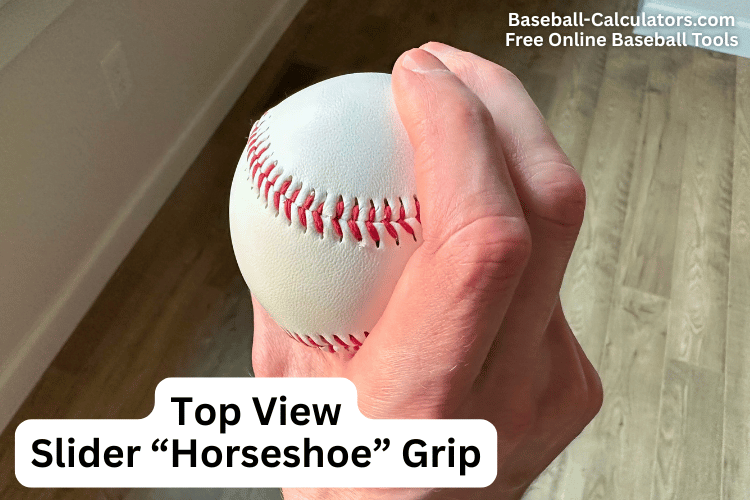
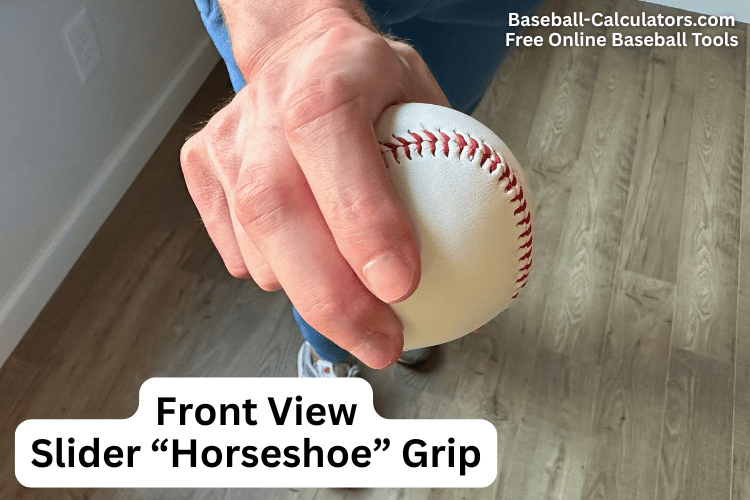
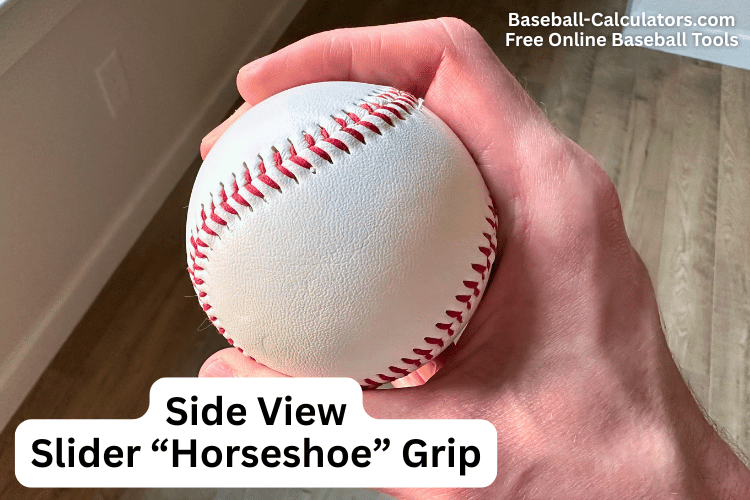
The middle finger typically rests right against the seam, while the index finger either shares that seam or rests on the smooth leather next to it. Some pitchers feel more spin control by letting the index finger float or spike slightly, depending on how much pressure they want to take off of it.
What makes this grip unique is the way it allows pitchers to “creep up” the side of the ball. By shifting the fingers slightly higher on the seam, it becomes easier to manipulate the ball’s axis during release, especially for pitchers trying to develop more horizontal sweep.
Because the fingers are positioned closer to the side of the ball than in a typical fastball grip, this version naturally encourages a tighter release angle and better side spin. This grip is popular with pitchers who are trying to generate more movement across the plate or are naturally good at supinating through release.
The “Across Offset” Slider Grip
The across offset slider grip is built off a traditional four-seam fastball grip but with a deliberate shift toward one side of the ball—usually in the direction of the horseshoe seam.
To begin, the pitcher holds the ball like a standard four-seam fastball, with the middle and index fingers placed across the wide seams. Then, instead of splitting the ball evenly, the grip is offset so the fingers lean more toward the glove-side seam.
Here I am showing this slider grip:


This subtle change allows the pitcher to apply more pressure to the side of the ball rather than behind it, setting up the ideal conditions for a slider’s spin. The middle finger does most of the work, digging into the seam for traction and control.
The index finger helps guide the release but often stays lighter on the ball, especially for pitchers who like to spike or stack it to reduce drag. This grip is a nice option for pitchers with fastball-dominant mechanics who want a slider that looks like a fastball out of the hand.
Because the setup is so similar to a four-seam grip, it’s a useful option for maintaining consistent arm speed and hiding the pitch’s identity longer. It can produce a tighter, shorter break than sweeping sliders and is often more forgiving for pitchers trying to locate it for strikes.
While it usually does not create as much horizontal movement as other grips, it blends deception and control, making it a good choice for tunnel-based pitch sequencing.
The “Stacked Spike” Slider Grip
I discussed this a bit earlier, but the stacked spike grip is a more specialized slider grip that alters finger positioning to help a pitcher apply focused pressure and better control the ball’s spin.
Instead of spreading the index and middle fingers evenly across the seam or the ball’s surface, this grip places the index finger directly against or even partially on top of the middle finger. This stacked position can also include spiking the index finger—bending it so the tip doesn’t touch the ball—and resting it firmly against the middle finger to keep it stable.
The purpose of this adjustment is to isolate spin control to the middle finger, which becomes the primary point of force during release. The ball is usually held with the seam in a two-seam or horseshoe orientation, depending on the pitcher’s preference.
The thumb sits underneath the ball, often on the seam, but because of the unusual finger position on top, the thumb’s placement may shift slightly to maintain balance. The stacked spike setup removes unnecessary pressure from the index finger and allows the pitcher to better feel the friction and direction of the spin coming off the middle finger.
Check out our other FREE online pitching tools:
- Gameday Pitching Tracker (NEW!)
- Gameday Pitch Stat Keeper (NEW!)
- Pitcher Batted Ball Rate Tracker (NEW!)
- Pitch Counter Tool
- Pitcher Stat Calculators
- Baseball Pitching Explained
It’s especially useful for pitchers whose sliders tend to blend with cutters or don’t separate clearly from the fastball, and for those struggling to create enough lateral movement. While this grip won’t be the first option for everyone, it’s a powerful tool for refining spin direction and maximizing movement in pitchers who respond well to it.
Slider Grip Common Thumb Placement
Thumb placement plays a bigger role in slider effectiveness than many pitchers realize. While it doesn’t generate the spin directly, it heavily influences how the ball sits in your hand, how cleanly it comes out, and whether you can stay consistent with your release.
There’s no one-size-fits-all placement for your thumb, but several patterns have emerged among pitchers at every level, and small tweaks can lead to meaningful differences in how the pitch moves.
The most traditional thumb placement is directly underneath the ball, resting along the smooth leather or hooking onto a seam. This position gives the hand a centered feel and keeps the ball stable as the fingers apply pressure to the side.
It’s especially common in more standard grips like the offset two-seam or horseshoe slider because it helps maintain balance and allows the ball to roll cleanly off the fingers. For pitchers who want a firm yet flexible grip, this neutral placement offers a good combination of control and spin potential.
Another variation shifts the thumb slightly off to the side, often toward the arm side of the ball. This creates a more diagonal grip across the ball’s surface, which can help the fingers work around the side and create the kind of sweeping spin associated with horizontal sliders.
There are also pitchers who tuck the thumb underneath the horseshoe, particularly those using a looser grip. This position allows the ball to come out earlier in the hand path, helping avoid an over-rotation that would pull the pitch off course.
Ultimately, thumb placement comes down to feel and functionality. The goal is to give your fingers the freedom to apply spin without locking the ball too tightly in the hand.
How to Release a Slider
Releasing a slider the right way is what separates a sharp, late-breaking pitch from one that backs up, floats, or hangs in the zone. The goal is to apply spin from the side of the ball rather than directly behind it, which means the wrist, fingers, and arm path all have to work together to create the correct spin axis.
While every pitcher may have slight differences in how they finish the pitch (mechanics differ from pitcher to pitcher), there are core principles that nearly all successful sliders have in common. At release, the key is to stay behind the ball as long as possible without staying directly on top of it.
Your hand should approach release in a slightly karate-chop-like position, with a stiff wrist and the palm facing inward—not fully pronated like a fastball and not turned over like a curveball. As your arm travels forward, your fingers should be positioned on the side of the baseball, and your middle finger should lead the way.
Think of pressing the side of the ball forward rather than pulling it down or snapping it off like a traditional curveball. The index finger should be the last point of contact, helping guide the ball and tilt the spin axis toward the glove side.
Check out our other FREE online pitching tools:
- Gameday Pitching Tracker (NEW!)
- Gameday Pitch Stat Keeper (NEW!)
- Pitcher Batted Ball Rate Tracker (NEW!)
- Pitch Counter Tool
- Pitcher Stat Calculators
- Baseball Pitching Explained
The finish is all about maintaining direction and control. After the ball leaves your hand, your arm should continue naturally toward the target without flying off to the side or decelerating early. A clean follow-through ensures your body stays in rhythm and your arm path remains consistent.
A quality slider should feel like a fastball in terms of effort and direction. The deception comes from the spin, not from a radically different throwing motion. When done correctly, the pitch should come out of your hand on the same plane as a fastball, then sharply dart away late.
Seam Orientation and Subtle Grip Differences
Though often overlooked, the orientation and direction of the seams on a baseball can influence how a slider feels coming out of the hand (and potentially how it performs).

While most players are aware of how to align their fingers regarding grip, few consider the direction in which the stitches run along those seams.
This detail, while small, may contribute to subtle but meaningful differences in grip comfort and, therefore, release consistency. Several elite Japanese pitchers (Yoshimi, Fujikawa, and Kaneko) have noted through personal experience that certain seam directions feel less slippery and help them generate more spin on certain pitches.
This is applicable to all slider grips, but to illustrate, I want to show this using the common “Offset” slider grip I discussed earlier in the article.
When using this offset grip, there are two different seam scenarios. Type 1 I have pictured below has the left seam pointing upward and the right seam pointing downward.

If you rotate the baseball, you then can see Type 2, which has the left seam pointing downward and the right seam pointing upward. This is the opposite of Type 1. I put a picture of type 2 below:

That minor shift in seam orientation can affect how the stitches feel against the pad of the middle finger. At the very least this can influence comfort, but for some pitchers this may even affect the outcome of the pitch.
To be clear, there is not a verified right or wrong seam direction (meaning, choose which one feels best for you). Most pitchers do not actively monitor seam direction, but because of that, many may unknowingly switch between seam orientations that feel similar but produce (potentially) slightly different results.
I personally like to throw it with the right seams pointing upward. I think this allows me to grip that seam better so I can finish through the inside of the ball at the point of release. Here is the seam orientation I prefer:
Still, each pitcher may (or may not) have their own preference.
Over time, these seam variations can show up as inconsistency in pitch movement, release feel, or command even when everything else seems unchanged. Because the difference is subtle, it is easy for pitchers to potentially miss what is actually going wrong.
This is why it might be worth tracking outcomes based on seam orientation. Paying attention to how the ball feels in the hand and monitoring whether certain seam directions correlate with better command, higher spin, or improved comfort. This article is a great resource to do a deeper dive on this issue.
Understanding the Basics of a Slider
| Slider Summary | |
|---|---|
| Speed at Pro Level | 85-95 mph |
| Movement | Sharp glove-side break Sweeping with vertical drop |
| Effectiveness | Late break fools hitters Hard to square up |
| Value | Confident strike pitch Tough vs same-side hitters |
Many professional hitters consider a hard-thrown slider to be the most devastating pitch in baseball. When sliders are thrown hard, they combine extreme velocity with sharp, violent breaking action.
As you can imagine, matching the barrel of the bat to a pitch like that is incredibly difficult. Hard sliders break so late that halfway to the plate they look like fastballs.
The Value of a Slider
When the hitter fires their hands, they think they’ve got a fastball, but by the time the bat reaches the zone, the late-break occurs an the pitch dives away from the bat.
“Sliders are so tough to identify and square-up that pitcher’s who have premium sliders feel very confident throwing them as strikes in the zone if needed.”
Sliders are so tough to identify and square-up that pitcher’s who have premium sliders feel very confident throwing them as strikes in the zone if needed. There are multiple planes on which a pitcher may choose to throw a slider.
Late dive from fastball Hard to square up Confident strikeout pitch
Sweeping or tight break Corner placement varies Horizontal + vertical
Lefty plane tough Opens front hip Disrupts swing path
When it is down in a corner of the strike zone, it may have a longer sweeping action to its finish. When the pitcher tucks it in on a corner for a strike, it often has a tighter break.
Here is an illustration of a couple common paths sliders will take:
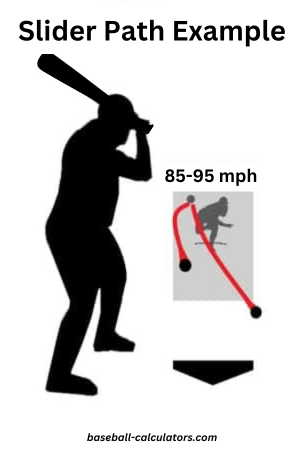
Left-handed sliders can be especially difficult to hit due to the plane that many left-handed pitchers throw off of. Lefty sliders can have long horizontal movement along with vertical break.

In general, horizontal movement can be dangerous for pitchers by itself (because it spends more time on the same plane as a swinging bat), but when sharp horizontal movement is combined with downward driving action (like what happens with a slider), it becomes very difficult for hitters to square-up, moving almost like the path of a frisbee.
Here is an idea of what many premium left-handed sliders look like:
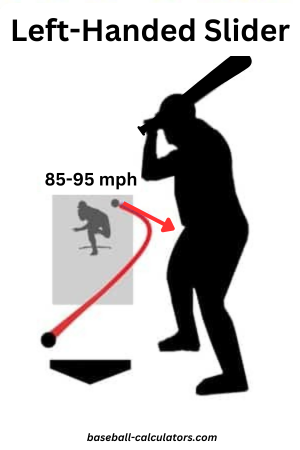
As you can imagine, these types of sliders are very difficult for left-handed hitters to hit. When hitters see the ball start behind them, their tendency is to let their front hip fly open (or to lock up).
Check out our other FREE online pitching tools:
- Gameday Pitching Tracker (NEW!)
- Gameday Pitch Stat Keeper (NEW!)
- Pitcher Batted Ball Rate Tracker (NEW!)
- Pitch Counter Tool
- Pitcher Stat Calculators
- Baseball Pitching Explained
When the front side flies open for a hitter, the swing-path is pulled that way with it, which means the swing path is no longer in the strike zone. Keeping the front side in is very important for hitters, and sweeping sliders make it difficult to fight the natural reaction of moving the front hip when it looks like the baseball is coming straight for it.
Common Mistakes When Throwing a Slider
Slider Grip is Too Tight
One of the most common mistakes pitchers make when learning to throw a slider is gripping the ball too tightly. It’s natural to want to hold on for control, especially when throwing a pitch that feels new or unfamiliar, but too much tension in the hand causes a chain reaction of problems.
A tight grip prevents the ball from slipping out cleanly, often leading to poor spin efficiency and a wobbly or flat break. It can also cause the wrist and forearm to tense up, which disrupts the smooth motion needed to create late, sharp movement.
The best sliders come from a grip that is firm enough to stay in control but loose enough to allow your fingers to do the work. When the ball rolls off the middle finger cleanly with just the right amount of friction, the spin tightens, and the pitch finishes with the movement you want. Letting go of that death grip is one of the first steps to getting the feel of a true slider.
Throwing the Slider Too Slow
A slider that’s intentionally thrown too slowly often loses what makes it dangerous in the first place. Many pitchers, especially when first learning the pitch, fall into the trap of slowing down their arm or easing off their effort in hopes of creating more movement.
But what actually happens is the opposite: the pitch floats, the break becomes early and easy to recognize, and hitters have more time to adjust. Sliders are most effective when they’re thrown with intent, using fastball-like arm speed and mechanics.
Check out our other FREE online pitching tools:
- Gameday Pitching Tracker (NEW!)
- Gameday Pitch Stat Keeper (NEW!)
- Pitcher Batted Ball Rate Tracker (NEW!)
- Pitch Counter Tool
- Pitcher Stat Calculators
- Baseball Pitching Explained
The late, sharp break that fools hitters relies on maintaining that same aggressive tempo. When the effort level drops, not only does velocity suffer, but the spin axis often shifts too, leading to pitches that either back up or hang in the middle of the zone. If the slider is going to miss bats or draw weak contact, it has to move late—and that only happens when it’s thrown hard.
Inconsistent Arm Speed
One of the fastest ways to lose the effectiveness of your slider is by tipping it with a different arm speed than your fastball. Hitters at every level are trained to pick up on subtle cues, and if your slider comes out of the hand slower or with a noticeably different effort, they’ll recognize it early and sit on it or lay off entirely.
A slider should be thrown with the same arm speed, intensity, and body mechanics as a fastball. The deception comes from the spin and movement, not a slower delivery. When pitchers slow their motion to try to “place” the pitch or overthink the break, it stands out like a red flag.
Keeping your delivery consistent across pitch types is one of the core principles of pitch tunneling, which helps your slider look like a fastball until the last moment. The sharper your deception, the harder it becomes for the hitter to read what’s coming.
A Loose Wrist
The position and firmness of your wrist at release are critical to throwing an effective slider, and one of the biggest mistakes pitchers make is letting the wrist roll, collapse, or flop during the throw.
A slider relies on tight, controlled spin that comes from applying force to the side of the ball—not from snapping the wrist like a curveball or letting it bend backwards mid-throw. When the wrist is too loose, the spin axis becomes unstable, often resulting in a pitch that either backs up with no break or spins flat and hangs in the zone.
However, if the wrist is too active or rolls through release, the ball may break inconsistently and become difficult to command. The key is keeping the wrist locked in a neutral, stable position throughout the delivery and especially during release.
This allows your fingers to apply precise pressure, creating the clean, late break that defines a quality slider. A firm wrist doesn’t mean a stiff or forced motion—it means controlled, intentional movement that stays connected to your arm path from start to finish.
Lack of Control
One of the most common reasons a slider becomes unreliable is a lack of consistency in how it’s delivered. Some pitchers change their arm slot without realizing it, shift their tempo, or adjust their body position during the throw (all of which can affect the pitch’s release point and spin axis).
When this happens, the slider might break too early, hang over the plate, or miss badly to the glove side, making it hard to throw for strikes or use in tight counts. For a slider to be effective in games, it has to be something you can trust in different situations, whether you’re ahead or behind in the count.
That trust only comes through repetition and refining the delivery until it becomes second nature. Building a slider you can control starts with learning to throw it with the same delivery as your fastball: same arm speed, same posture, same timing.
Check out our other FREE online pitching tools: