
The “2 seam” fastball is one of the most important pitches in baseball. The 2-seam fastball grip allows pitchers to create spin as the ball is released, which causes late, deceptive sinking action and makes this pitch very effective.

The 2-seam fastball’s late sinking movement is always to the pitcher’s arm-side. The 2-seam fastball is different than the 4-seam fastball because the 2-seamer has this late diving action (the 4-seamer is straighter but holds more velocity because it is straighter).
Check out our other FREE online pitching tools:
- Gameday Pitch Log Tracker (NEW!)
- Gameday Pitcher Stat Tracker (NEW!)
- Pitcher Batted Ball Tracker (NEW!)
- Pitch Counter
- Pitcher Stat Calculators
- How to Throw a Slider
The late movement on “2 seam” fastballs makes it an effective way to miss the barrel of a bat. Because of that, the effectiveness of a “2 seam” fastball ultimately comes down to the quality of the pitch’s arm-side break. In this article let’s discuss how to grip a 2 seam fastball, and the importance of this pitch for success.
How to Grip a 2 Seam Fastball
The two-seam fastball grip starts with placing your index and middle fingers along the two narrow seams that run close and parallel to each other on the baseball. These seams form the foundation of the pitch and are where the pitch gets its name.
Here is a look at the 2 seam fastball grip:
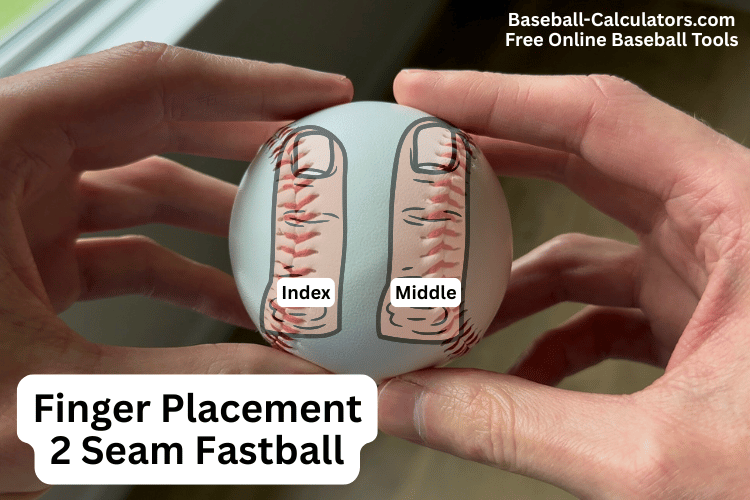
Your fingers should rest directly on top of the seams or slightly to the inside edge, depending on what feels most natural in your hand. Most pitchers use the pads or fingertips of their index and middle fingers, pressing just enough to maintain a secure hold without squeezing too tightly.
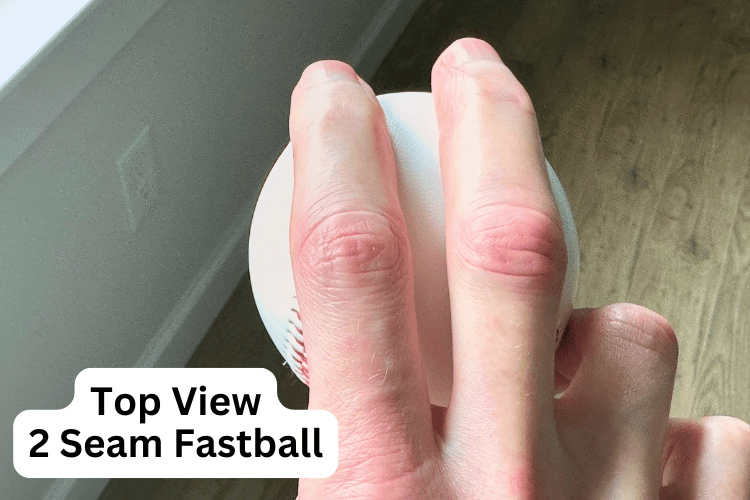
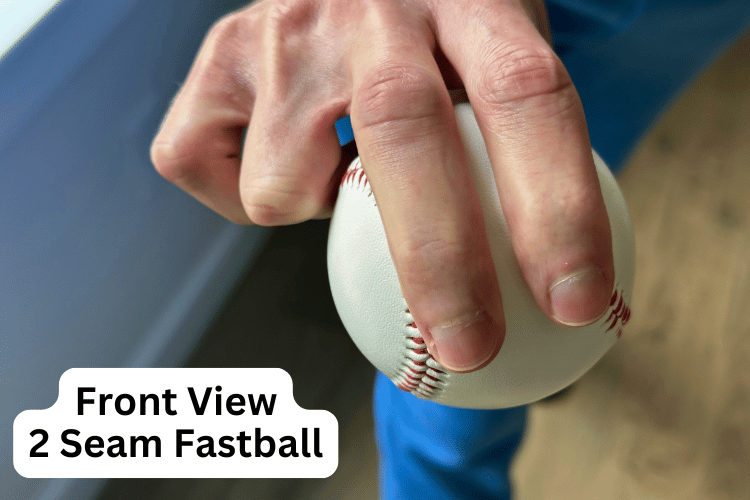

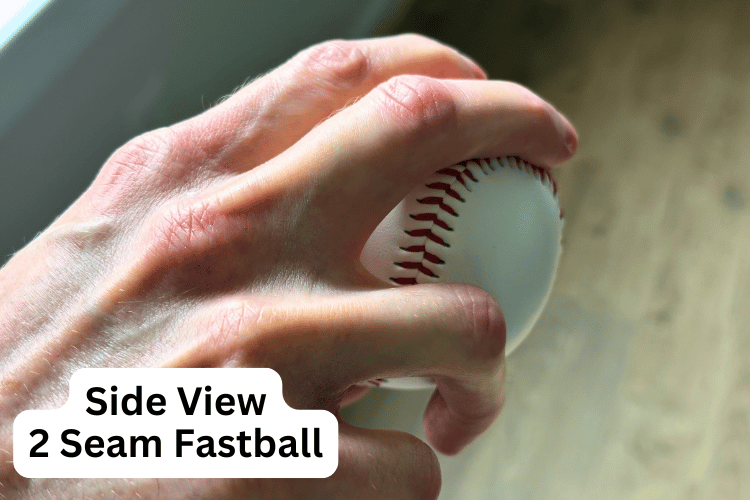
The purpose of placing your fingers on the seams is to help generate friction and spin as the ball comes out of your hand, which creates the signature arm-side run and light sinking action of the two-seam fastball.
Your thumb provides the base of the grip. It usually sits underneath the ball, either directly centered or just slightly offset.

This positioning gives the hand balance and control through the throwing motion. When the thumb is in the right spot, it acts like a stabilizer, helping your fingers apply pressure during the release.
Check out our other FREE online pitching tools:
- Gameday Pitch Log Tracker (NEW!)
- Gameday Pitcher Stat Tracker (NEW!)
- Pitcher Batted Ball Tracker (NEW!)
- Pitch Counter
- Pitcher Stat Calculators
- Baseball Pitching 101
A poorly placed thumb can throw off your grip and affect how the ball comes out. Some pitchers find that adjusting the thumb just slightly to the side gives them better command or more comfort, so it’s okay to experiment with small changes in placement (some pitchers use a tucked thumb pictured below).

Your ring finger plays a supporting role in this grip. It sits along the side of the baseball and helps you maintain a steady hold throughout your throwing motion.
While it does not control spin, the ring finger keeps the ball from wobbling or slipping during the delivery. The pinky finger is usually not involved in generating force or spin. It often hangs off the side or lightly touches the leather for balance.
Some pitchers keep the pinky off the ball entirely, especially if they have smaller hands or want to reduce tension in their grip. The grip itself should feel secure but relaxed.
You want to hold the ball firmly enough so that it doesn’t shift in your hand, but not so tight that your fingers get stiff. A tense grip can limit the natural movement of the ball and cause you to lose velocity.
On the other hand, a loose grip may lead to poor control or inconsistent movement. Finding the right balance is key. Your fingers should be positioned in a way that allows them to stay behind the ball as long as possible during your delivery (while finishing through the inside of the ball).
Ultimately, the 2-seam grip that works for one player might not feel right for another. That’s why many coaches suggest starting with the traditional grip and then making small changes based on what feels and works best.
“Most coaches suggest starting with the traditional grip and then making small changes based on what feels and works best.”
Even minor changes to finger spacing or thumb position can change how the ball behaves. The more you practice with the grip, the better feel you’ll develop for how to control the ball and get the movement you want.
Close-Grip Variation of 2 Seam Fastball Grip
The close-grip variation, as the name would suggest, brings the index and middle fingers closer together than the standard 2-seam grip. This is what this tighter 2 seam fastball grip looks like:

Instead of resting both fingers directly on the seams, many pitchers using this grip shift them slightly inward, placing on the inside part of the seam. This grip still allows for movement, but in some cases it may reduce the amount of spin and overall velocity compared to the standard grip.
Many pitchers use this close-grip variation, and often it just comes down to finger size and comfort.
Check out our other FREE online pitching tools:
- Gameday Pitch Log Tracker (NEW!)
- Gameday Pitcher Stat Tracker (NEW!)
- Pitcher Batted Ball Tracker (NEW!)
- Pitch Counter
- Pitcher Stat Calculators
- Baseball Pitching 101
The thumb placement is generally the same as with the standard grip—underneath the ball and slightly off-center—but some pitchers may shift it slightly inward as well to match the change in finger positioning.
The ring finger stays on the side of the ball for support, and the pinky again rests off the ball or very lightly touches it. The fingers’ tight spacing creates a firmer feel in the hand, which can improve grip strength and stability during the throw.
“Many pitchers use this close-grip variation, and often it just comes down to finger size and comfort.”
Because this grip variation reduces friction with the seams, it might result in less spin and a smoother release. This can lead to less movement overall, but it may provide better control for pitchers who struggle with the standard grip or are still developing their mechanics.
Wide-Grip Variation of the 2 Seam Fastball Grip
The wide-grip variation spaces the index and middle fingers farther apart. The fingers still contact the seams, but on the outside part of the seams.
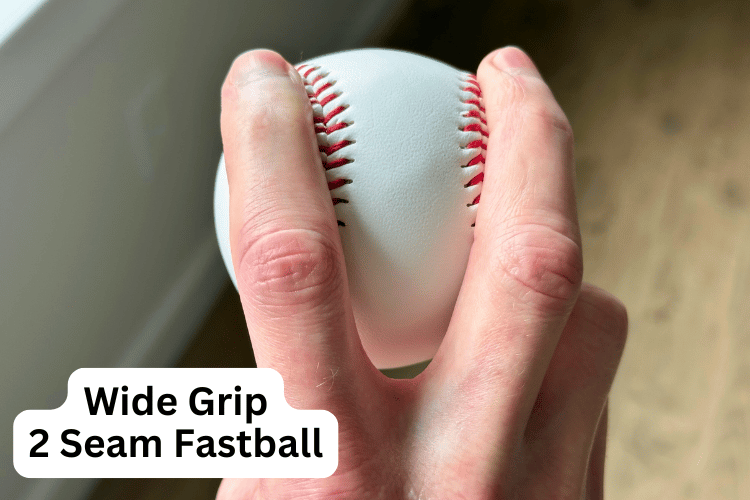
This placement reduces the spin rate and often lowers the pitch’s velocity. In many cases, the pitch starts to resemble a splitter because of its drop and reduced spin profile. This grip is not often used.
The thumb remains underneath the baseball for balance, but you may need to adjust its position to match the wider finger placement. The ring finger continues to support the ball on the side, while the pinky typically floats off the edge.
“When you use a wider grip, the pitch starts to resemble a splitter more than a 2-seamer.”
Despite the drop in spin and speed, the wide grip can be useful for certain situations. Some pitchers turn to this grip when they want to increase movement (can make the ball dive more sharply or fade), making it difficult for hitters to square it up.
To be clear, this version is often used as a specialty grip and shouldn’t be thought of as a perfect replacement to the standard 2-seam fastball grip. It is best suited for pitchers who have already developed good feel and command with the standard two-seam grip and are ready to explore other situational variations.
Thumb Variations for the Two-Seam Fastball
When gripping a 2-seam fastball, most pitchers start with their thumb placed directly underneath the ball, lined up with the space between the index and middle fingers. This placement gives a strong base of support and helps balance the ball during the throwing motion.
It also allows your fingers to apply consistent pressure as the ball leaves your hand. However, some pitchers find better comfort or movement by shifting the thumb slightly off-center.
Moving the thumb a little toward the index finger might help increase spin or improve command. Other pitchers may move the thumb slightly toward the middle finger to reduce tension or adjust for hand size.
Check out our other FREE online pitching tools:
- Gameday Pitch Log Tracker (NEW!)
- Gameday Pitcher Stat Tracker (NEW!)
- Pitcher Batted Ball Tracker (NEW!)
- Pitch Counter
- Pitcher Stat Calculators
- Baseball Pitching 101
These small shifts can have a big impact on how the ball comes out of your hand and how much arm-side run or sink it produces. Thumb pressure is another factor to consider.
Some pitchers apply light pressure with the thumb, using it mainly for support. Others grip the ball more firmly, pressing the thumb upward to help guide the ball out cleanly.
“A tight grip with the thumb can improve control but might reduce movement.”
A tight grip with the thumb can improve control but might reduce movement. A looser grip may allow for more natural spin but can be harder to command. Experimenting with pressure and position can help you find what works best for your hand shape and throwing style.
I put a photo below of the tucked thumb grip that some pitchers use:
The important thing is to find a thumb placement that feels stable and allows you to stay behind the ball during your release. If the thumb slips or feels awkward, the pitch may lose its intended movement.
Seam Orientation and Subtle Grip Differences
Though often overlooked, the orientation and direction of the seams on a baseball can influence how a 2 seam fastball feels coming out of the hand (and potentially how it performs).

While most players are aware of how to align their fingers across the seams, few consider the direction in which the stitches run along those seams.
This detail, while small, may contribute to subtle but meaningful differences in grip comfort and, therefore, release consistency. Several elite Japanese pitchers (Yoshimi, Fujikawa, and Kaneko) have noted through personal experience that certain seam directions feel less slippery and help them generate more spin on certain pitches.
Check out our other FREE online pitching tools:
- Gameday Pitch Log Tracker (NEW!)
- Gameday Pitcher Stat Tracker (NEW!)
- Pitcher Batted Ball Tracker (NEW!)
- Pitch Counter
- Pitcher Stat Calculators
- Baseball Pitching 101
When gripping a 2 seam fastball, there are two different seam scenarios. Type 1 I have pictured below has the left seam pointing downward and the right seam pointing upward.

If you rotate the baseball, you then can see Type 2, which has the left seam pointing upward and the right seam pointing downward. This is the opposite of Type 1. I put a picture of type 2 below:
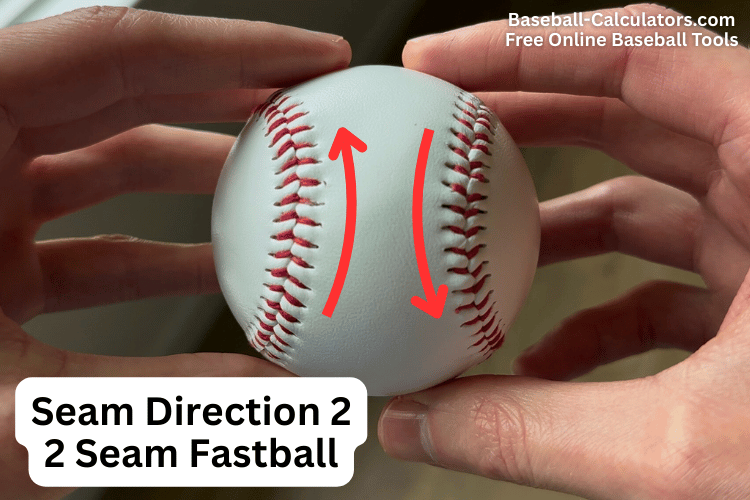
That minor shift in seam orientation can affect how the stitches feel against the pads of the fingers. At the very least this can influence comfort, but for some pitchers this may even affect the outcome of the pitch.
To be clear, there is not a verified right or wrong seam direction (meaning, choose which one feels best for you). Most pitchers do not actively monitor seam direction, but because of that, many may unknowingly switch between seam orientations that feel similar but produce (potentially) slightly different results.
I personally like to throw it with the right seams pointing upward. I think this allows me to grip that seam better so I can finish through the inside of the ball at the point of release. Here is the seam orientation I prefer:
Still, each pitcher may (or may not) have their own preference.
Over time, these seam variations can show up as inconsistency in pitch movement, release feel, or command even when everything else seems unchanged. Because the difference is subtle, it is easy for pitchers to potentially miss what is actually going wrong.
This is why it might be worth tracking outcomes based on seam orientation. Paying attention to how the ball feels in the hand and monitoring whether certain seam directions correlate with better command, higher spin, or improved comfort. This article is a great resource to do a deeper dive on this issue.
How to Release a Two-Seam Fastball
Pitchers who want arm-side run or sink will often feel like they are finishing the pitch with their fingers working through the inside of the ball. Finishing on the inside of the baseball creates the type of spin needed to make the pitch run or sink.
“Pitchers who want arm-side run or sink will finish the pitch with their fingers working through the inside of the ball.”
To finish on the inside of the baseball, some pitchers will pronate their wrist (turn their wrist) at the release towards the inside of the baseball so that they can finish through the inside of the ball.
Remember, if you finish through the middle of the ball, you will have a straighter pitch (which is not what we want with the 2 seamer).
Also, some pitchers may tilt their wrist angle through the pitching motion so that the angle of the wrist allows them to finish on the inside of the baseball (this is slightly different than actually rotating the wrist at release). Click here to see an example of that.
Your hand should follow through naturally toward the target while allowing the ball to roll off the fingers with a slight tilt.
Check out our other FREE online pitching tools:
- Gameday Pitch Log Tracker (NEW!)
- Gameday Pitcher Stat Tracker (NEW!)
- Pitcher Batted Ball Tracker (NEW!)
- Pitch Counter
- Pitcher Stat Calculators
- Baseball Pitching 101
Pitchers with a lower arm slot naturally throw the ball on a tilted axis, which encourages more sidespin and helps the pitch sink or tail. If you throw from a higher arm slot, you may need to adjust by shifting your wrist slightly to “come around” the ball.
This can help you get the movement even if your delivery is more upright. A clean release comes from repetition. The more you throw it, the more you’ll develop a feel for how much pressure to apply and how to finish your motion.
Understanding 2 Seam Fastball Basics
| 2-Seam Fastball Summary | |
|---|---|
| Speed at Pro Level | 85-95 mph Some exceed 95 mph |
| Movement | Late arm-side break Right for RHP, left for LHP |
| Effectiveness | Misses barrels with late break Induces weak contact |
| Value | Neutralizes opposite-handed hitters Jams same-sided hitters |
An effective “2 seam” fastball is considered to be one of the nastiest pitches in Major League Baseball. It can carry extreme velocity up to 95 mph (some pitchers may even exceed 95), but what makes it devastating is the late arm-side movement.
A combination of elite velocity, like 95 mph, and late movement makes it very difficult for batters to square-up the baseball. The movement of a “2 seam” fastball is always arm-side (in reference to the arm-side of the pitcher).
“The movement of a ‘2 seam’ fastball is always arm-side (in reference to the arm-side of the pitcher).”
So, for a right-handed pitcher, the ball with break to their right (the pitcher’s right), and for a left-handed pitcher, the ball will break to their left.
Here is an illustration of arm-side movement for “2-seam” fastballs:

The late movement on “2 seam” fastballs makes it an effective way to miss the barrel of a bat. Because of that, the effectiveness of a “2 seam” fastball ultimately comes down to the quality of the pitch’s arm-side break.
If the late break is too subtle, it may not move enough to miss the barrel of the bat. But if the late movement is extreme, this pitch is an effective way to cause weak contact or even swings and misses.
The Value of a 2 Seam Fastball
One issue professional pitchers commonly have is getting opposite-handed hitters out consistently. For example, a right-handed pitcher may often struggle against left-handed hitters.
“One issue professional pitchers commonly have is getting opposite-handed hitters out consistently.”
The main reason for this is hitters on the opposite side of the plate from a pitcher’s throwing arm can see the release point easier (which makes it more comfortable), and the ball must travel farther to get in on their (the hitter’s) hands.
Can use against oppo-hand Aims at hip, breaks in Locks up front side
Starts middle, jams Late movement key Induces weak contact
Misses barrels May have diving action Boosts effectiveness
In the 2024 Major League Baseball season, right-handed pitchers league-wide held right-handed hitters to a .302 wOBA, but were less effective against left-handed hitters, who posted a .319 wOBA (wOBA = weighted on base average, a “catch-all” offensive statistic, read more here).
And in the 2024 Major League Baseball season, left-handed pitchers league-wide held left-handed hitters to a .295 wOBA, but were less effective against right-handed hitters, who posted a .316 wOBA.
“In the 2024 Major League Baseball season, right-handed pitchers league-wide held right-handed hitters to a .302 wOBA, but were less effective against left-handed hitters, who posted a .319 wOBA.”
I cite the statistics above to again illustrate that when pitchers face opposite-handed hitters, they are generally at a disadvantage. Right-handed pitchers struggle more against left-handed hitters, and left-handed pitchers struggle more against right-handed hitters (there can obviously be exceptions).
Check out our other FREE online pitching tools:
- Gameday Pitch Log Tracker (NEW!)
- Gameday Pitcher Stat Tracker (NEW!)
- Pitcher Batted Ball Tracker (NEW!)
- Pitch Counter
- Pitcher Stat Calculators
- Baseball Pitching 101
Despite this, some right-handed pitchers are very effective versus left-handed hitters. One trait that many of those pitchers have is a quality 2- seam fastball that they use to neutralize left-handed hitters (this can also work vice-versa meaning left-handed pitcher vs right-handed batter).
To neutralize left-handed hitting, a right-handed pitcher can start a hard “2-seam” fastball right at the front hip of a left-handed batter, then see the late movement on the pitch draw the pitch back into the inside part of the strike zone. I illustrated this strategy below:

This pitch, when executed correctly, is difficult for left-handed hitters to deal with because when the ball releases out of the pitcher’s hand, it looks like it might hit them (the batter) in the hip or ribs or leg, and so their front side often freezes or flies open.
And then, when the pitch moves late, they’re not ready to swing and the pitch has effectively “locked them up”. A pitcher may also start a 2-seam fastball out over the middle of the plate and let the late movement carry the ball out of the strike zone to try and induce a swing and miss or weak contact.
“As with any pitch in baseball, the later the movement, the better. When a pitch breaks early, the hitter sees it and adjusts.”
A 2-seam fastball can also be very effective against a same-sided hitter. For example, a right-handed hitter can start a 2-seamer over the middle of the plate and watch the late movement draw the pitch back inside and jam the hitter.
As with any pitch in baseball, the later the movement, the better. When a pitch breaks early, the hitter sees it and adjusts. When a ball moves late, the hands of the hitter are already committed, and the outcome of late movement is usually a missed bat or weak contact, both of which are wins for the pitcher.
Sinker vs 2 Seam Fastball
Some pitchers refer to a 2-seam fastball as a “sinker”. This is due to the late sinking (or diving) action that occurs when many pitchers throw this pitch.
“Some pitchers refer to a 2-seam fastball as a “sinker”.”
Professional pitchers can adjust the type of movement they get on this pitch by finger placement and where they put pressure on the ball as they release it. All of these things (included with other types of pitching mechanics like release point and arm angle) can produce different types of movement.
More horizontal break Late arm-side move Varies by pitcher
More vertical sink “Heavy” drop Often a 2-seam variant
Grip & mechanics differ Affects movement type Names overlap
When comparing a 2-seam fastball vs sinker, although they can often refer to the same type of pitch, a traditional 2-seam fastball has more horizontal movement and the sinker has more vertical (sinking) movement.
It is important to remember that no two pitchers are exactly alike. Arm angles, release points, seam grips, height, arm strength, wrist movement, all these types of things will vary from pitcher to pitcher.
“It is important to remember that no two pitchers are exactly alike. Arm angles, release points, seam grips, height, arm strength, wrist movement—all these things vary from pitcher to pitcher.”
This means that on any given pitch, one pitcher may get different movement than other pitchers, even if they are both attempting to throw the same pitch.
For those pitchers who get extra sink (often referred to as “heavy” sink) on the 2-seam fastball, they will often refer to their 2-seamer as a “sinker” due to this distinguishing heavy-sink characteristic. Therefore, even though the sinker and 2-seam fastball are not exactly the sam
2 Seam Fastball Grip Mistakes
Placing Fingers Too Far Off the Seams
When your index and middle fingers are placed too far off the seams, you lose the key friction needed to produce consistent spin and movement. The seams act like tracks that guide your fingers and allow them to grip the ball properly during the throw.
Without seam contact, the ball tends to slip or rotate unevenly, which weakens the pitch and makes it easier for hitters to track. You may also notice a drop in command and feel, especially if the ball moves differently each time.
Check out our other FREE online pitching tools:
- Gameday Pitch Log Tracker (NEW!)
- Gameday Pitcher Stat Tracker (NEW!)
- Pitcher Batted Ball Tracker (NEW!)
- Pitch Counter
- Pitcher Stat Calculators
- Baseball Pitching 101
A proper two-seam grip relies on using the seams as contact points, not just for comfort but for control. Even a slight shift in finger placement can mean the difference between a pitch that runs to the arm side and one that just floats in flat.
Gripping the Ball Too Tightly
Gripping the ball too tightly is a common mistake that can reduce both the effectiveness and comfort of your two-seam fastball. When your fingers are tense, it restricts wrist movement and creates unnecessary strain through your hand and forearm.
This tightness makes it difficult for the ball to come out of your hand smoothly, often leading to a forced release that reduces spin and causes the pitch to miss its target. It may also result in a pitch that stays straight or flattens out rather than running or sinking.
The ball should feel secure but not jammed into your hand. A relaxed grip gives your fingers room to apply natural pressure and allows for a more fluid throwing motion, which helps create better spin, velocity, and movement.
Not Staying Behind the Ball at Release
Failing to stay behind the ball during the release is one of the main reasons a two-seam fastball loses its intended movement. When your fingers drift off to the side too early or your wrist opens up too soon, the ball comes out without the clean, centered pressure that drives movement.
This often results in a pitch that spins incorrectly or lacks the sidespin needed for arm-side action. Staying behind the ball gives your index and middle fingers a longer path to apply pressure and create movement as the ball leaves your hand.
“This is what makes the 2 seam fastball one of the harder pitches to master.”
But it’s also important to remember that even though we want to stay behind the ball, we do need to finish through the inside of the baseball. This is what makes the 2 seam fastball one of the harder pitches to master.
Pitchers who stay behind the ball also tend to throw with better command and more consistency because they are able to drive the pitch directly toward the target rather than cutting it off early or releasing it too soon.
Letting the Thumb Drift Too Far to the Side
The thumb acts like a support beam in the two-seam fastball grip. If it drifts too far to the side, the entire grip can become unbalanced and harder to control.
A misplaced thumb often shifts the pressure toward one finger more than the other, which can cause the ball to spin awkwardly or come out with poor direction. The thumb should sit under the ball or slightly off-center based on comfort, but it should always help keep the ball steady through the throw.
2 seam fastball grip thumb placement:
When the thumb slips out of position, pitchers often feel the ball wobble in their hand or notice a lack of consistency in how the pitch moves. Proper thumb placement adds stability to the grip and allows the fingers on top to work together more effectively during the release.
Ignoring Comfort
Ignoring comfort when selecting a grip is a mistake that can affect nearly every part of your delivery. If the ball doesn’t feel right in your hand, it’s hard to stay relaxed and throw with confidence.
Many pitchers copy a grip they’ve seen without adjusting it for their hand size, finger length, or throwing style. This leads to tension and inconsistency, especially under pressure. A grip that feels awkward often causes timing issues or reduces feel for release.
And remember, as I discussed earlier, the direction of the seams may affect comfort and how the ball feels as you release it (something to consider):
Comfort should always be the starting point when choosing a two-seam grip. The more natural the grip feels, the more consistently you’ll throw it, and the more likely you’ll be to develop command and movement over time.
Check out our other FREE online pitching tools: